
Macomb County Previous Residents by Era
One Macomb address appears in overlapping sources, not a single continuous online list. Start with current assessment and map data to freeze the parcel, then use the Register of Deeds for the recorded transfer chain. The historical layer changes with the era: plat maps explain the lot, Sanborn maps show the building context, the Mount Clemens directory index and census schedules point to named households, and newspapers or probate may close the trail. A result should say what the source actually supports, such as recorded owner, directory occupant, map feature, or estate party.
| Macomb source | Period represented | Where it is held | What it can establish |
|---|---|---|---|
| Assessment and GIS parcel data | Current public system; oldest online coverage not stated | BS&A Online, local assessor, and Macomb GIS | Tax ID, situs and mailing fields, legal description, geometry, and current owner or taxpayer |
| Recorded deeds and liens | Online oldest year not stated | Macomb County Register of Deeds | Grantor, grantee, record date, document placement, legal description, and recorded transfer trail |
| County assessment history | General rolls 1838-1870 and from 1950; Mount Clemens rolls begin 1879 | Archives of Michigan and local routes | Ownership, valuation, and parcel-continuity context |
| Mount Clemens directory index | 1896-1966 | Mount Clemens Public Library | Name-to-volume lead for historical address and household research |
| Federal census and local 1930 index | Released schedules through 1950 | National repositories and the library | Household, age, birthplace, and period address context |
| Sanborn maps, plats, newspapers, and probate | Varies by collection and locality | Library, Register, Archives, and court channels | Building, lot, event, death, estate, or heir context |
The county Register of Deeds does not publish a clean oldest online index year. That makes the counter, staff search, mail form, library tract-book holdings, and archives meaningful fallbacks for older Macomb property work. A blank web result does not prove an early instrument or prior resident trail is absent.
Start Macomb County Past Residents
The backward trail starts by freezing the modern parcel. In BS&A Online for Macomb County, an address, name, or parcel-number search can lead to owner or taxpayer information, the situs address, mailing address, tax information, and municipal details where supplied. In the Macomb GIS Parcel Explorer, a selected parcel can add its tax ID, community, legal description, geometry, and links to assessing data. Record the search date as well as the fields.
Situs means the physical parcel address. A mailing address is the destination for tax correspondence and can belong to an owner, trust, estate, or other contact outside the county. Neither record alone proves that a person lived at the site. When an address has units, GIS All Known Address searches the E911 database and can recognize apartment, condominium, or mobile-home units that sit under one tax parcel. That unit layer should not be turned into a list of people.
Macomb County Address History
In an address trail, a legal description is the tie between an old street number and the land named in a deed. It may use a subdivision, lot, plat book, liber and page, or metes-and-bounds wording. Macomb's GIS guide gives a hyphenated Sidwell tax-ID format, such as 14-22-452-004, and shows how a partial number can narrow a search. The guide's documented sample links a parcel to its community and a plat-based description, which is the kind of comparison needed before following a deed backward.
Street names can also create false negatives. The Mount Clemens guide lists Boyer to Highland in 1896, Front to Broadway in 1925, First to AmVet Drive in 1957, and a Gratiot North and South change beginning in 1994. Search both the period and current name, then test the result against the parcel, plat, Sanborn map, or deed. Do not assume a similar street number on a renamed road represents the same tract.
Trace Macomb County Previous Residents
The Register of Deeds supplies a recorded ownership chain, not a complete household list. Start with the owner or taxpayer identified in BS&A or GIS, then search that name as a grantee in the county's grantor-grantee index. The purchase deed identifies the seller, the recording date, and a legal description to compare with the parcel. Next, search the seller as a grantee to locate that earlier acquisition. Repeat the same process back through the chain, checking initials, spouses, trusts, estate names, business names, and reasonable spelling variants.
- Record the current tax ID, community, situs address, legal description, and current owner or taxpayer field.
- Use the Register of Deeds search options to find the current owner's purchase deed as grantee.
- Copy the grantor, grantee, recording date, document number or liber and page, and legal description exactly.
- Search the earlier seller as grantee, compare that legal description, and continue one transfer at a time.
- Use public counter terminals, a staff search, or the mail form when an online result is incomplete or an earlier range is needed.
- Grantor
- The party transferring an interest in the recorded document.
- Grantee
- The party receiving the recorded interest. Searching a prior seller as grantee usually locates that party's earlier purchase.
- Chain of title
- The sequence of recorded transfers for the same land, confirmed by matching legal descriptions rather than by street number alone.
- Legal description
- The lot, plat, metes-and-bounds, or other land description that identifies the recorded property.
The Register of Deeds recorded-document status page shows the county's indexing and verification context.
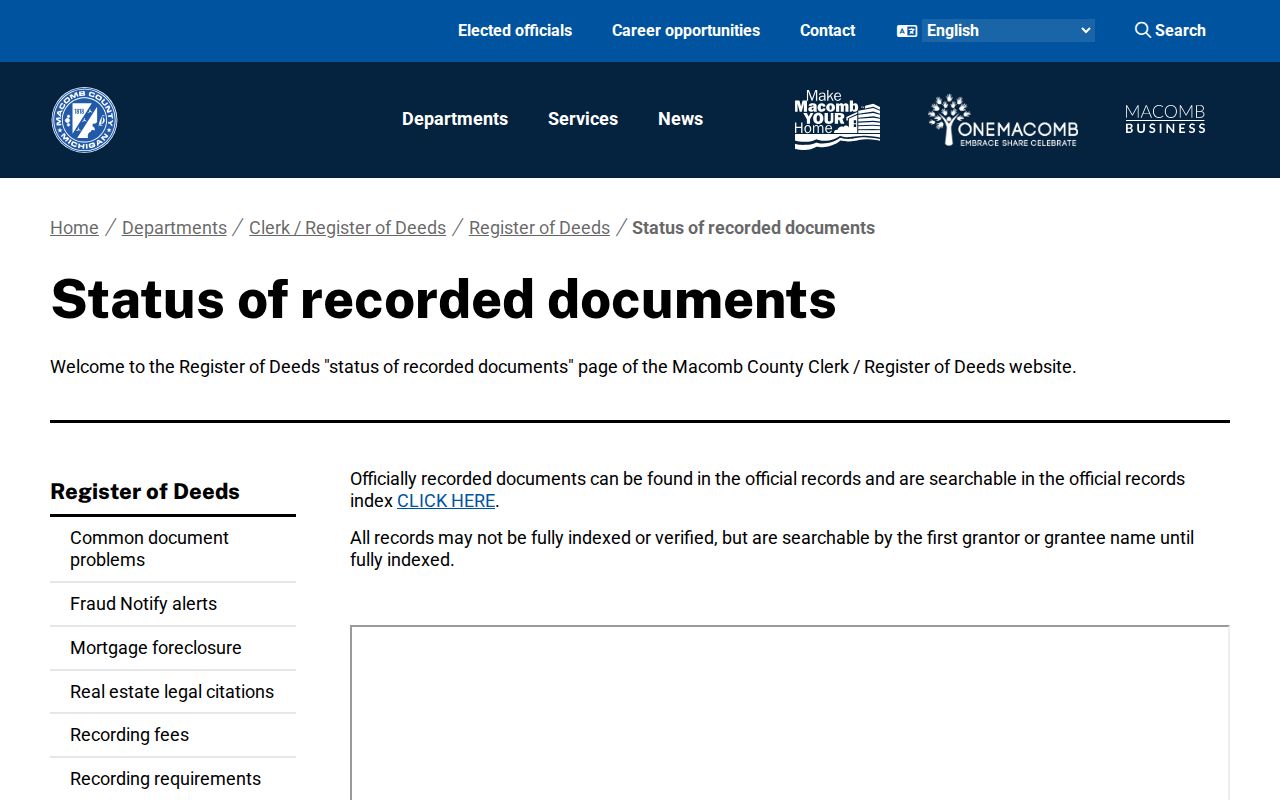
An in-progress indexing notice is a reason to verify through another county access channel, not a reason to conclude the transfer never occurred.
Macomb County Past Residents Caution
Macomb's basic land search is free. The Register also offers advanced subscription searching, free public terminals, staff searches in person or by mail, and a request form. The office states a $5 staff-search charge plus $1 per copy page; the mail form also calls for one search per form and supplies fields for the owner or grantee, type of document, address, parcel ID, year, and liber or page. Certified-copy and document-purchase choices follow separate rules.
Do not treat the online index as complete at every moment. The county explains that basic searching starts with the first grantor or grantee name, while address, legal-description, and parcel-ID options in advanced searching depend on full indexing and verification. A newly recorded or partly indexed item may not answer a broad search. The careful response is to note the date and mode searched, then use the counter, mail request, or Library and Archives routes if the era matters.
Note: A mortgage, release, lien, or quitclaim record can be part of the parcel history, but none by itself proves a person occupied the address.
Pair Macomb County Directory Years
Recorded owners are only one layer of an address history. At each owner era, pair the name with the Mount Clemens directory index, then inspect the cited volume. The documented index covers 1896 through 1966. Its collection is described in more detail in the Macomb City Directories collection, while this address trail uses a directory as a dated household lead. Compare each directory year with the closest released federal census schedule. Census records can add household members, ages, birthplaces, and a period snapshot that a deed does not provide.
- For each recorded owner era, search the surname, initials, maiden or married form, and period street name in the directory index.
- Inspect the cited directory volume and record its year, title, page, exact entry, and whether a street section confirms the address.
- Pair the entry with the nearest released census year, including 1900 through 1950 where applicable.
- Use the library's obituary, cemetery, funeral-home, probate, and newspaper indexes to test a move, death, or family transition.
- Mark unresolved years as gaps rather than filling them with an assumption about who lived there.
The local 1930 census index, yearbook index, church material, and funeral-home records can be helpful when a name is common. A directory entry may show an address or business connection, but it does not automatically identify every person associated with that address.
Macomb County Previous Residents Maps
Sanborn maps, plats, and local-history sketches help separate the building from the people connected to it. Mount Clemens examples in the research include Sanborn years 1888, 1892, 1897, 1903, 1909, 1921, and 1930 corrected to 1945. They can show a building footprint, material, use, street setting, and changes that give an address sequence meaning. A plat can bridge a lot and subdivision to the parcel description. Neither map type identifies a complete household.
The library's property-history model is especially useful because it combines sources rather than presenting one as conclusive. Its Railroad Inn and LeFevre grocery to Moose Lodge sketch draws on a 1808-1965 abstract of title, 1865 Warsaw plat, 1875 atlas, 1888-1930 Sanborn maps, 1870, 1880, and 1900 census records, city directories, and obituaries. That approach keeps building history, recorded ownership, and household evidence in separate columns.
The Mount Clemens library resource directory includes the Property History address-search route and related local resources.
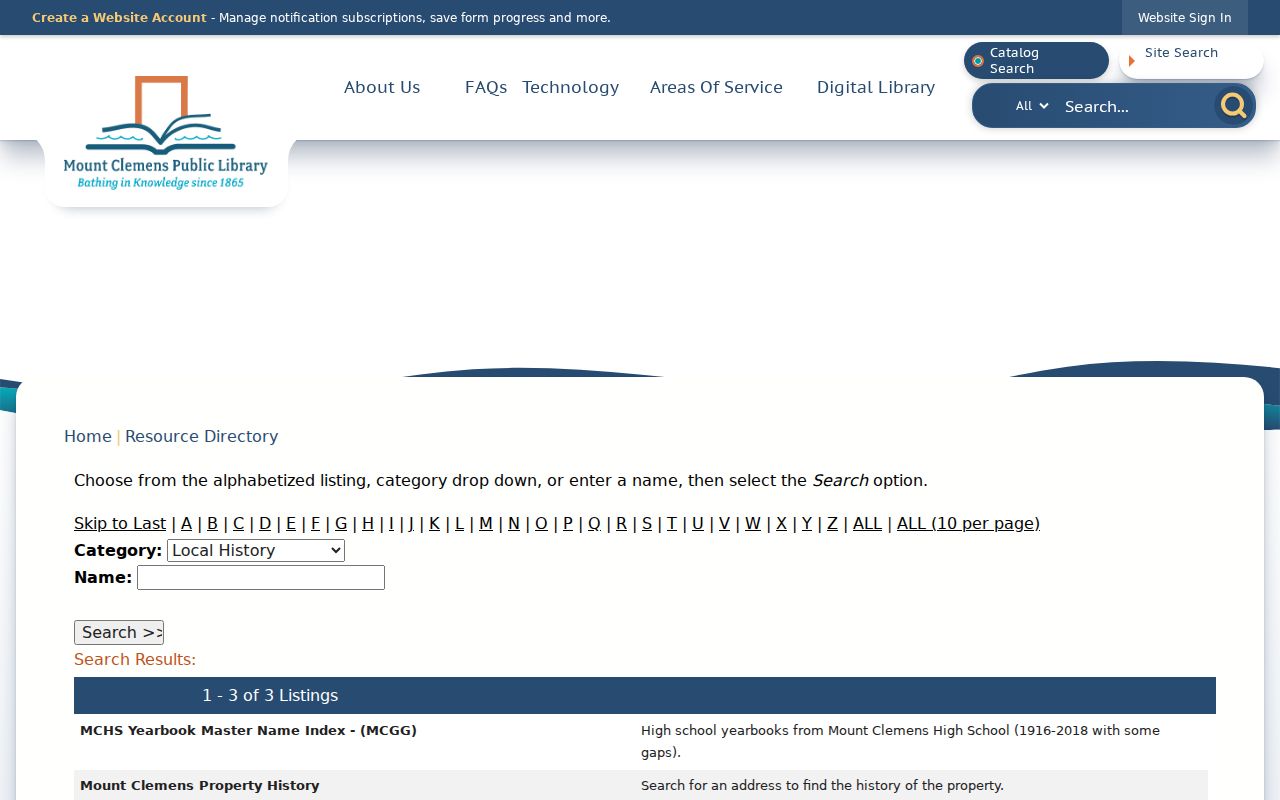
Use a library sketch as a documented lead to the listed sources, then inspect the deed, map, directory, or census record it names.
Macomb County Past Residents Endpoints
Obituaries and probate often close an address trail. The Mount Clemens library's Obituary Index begins in 1941 and has some older material; its newspaper runs also have gaps. An obituary may name relatives, a final place, a funeral provider, or cemetery information. Probate can identify a decedent's estate, heirs, petitions, inventory, or later recorded transfer when the file is public. A death certificate is a separate record and follows its own state access rules.
When an address lead stops, move through the documented fallback chain: municipal assessor for a local card or renumbering question; Register of Deeds counter or mail search for a recorded document; library index or microfilm for a historical household lead; and Archives of Michigan for older county assessment, probate, tax, voter, naturalization, or court groups. The Archives guide identifies general Macomb assessment rolls from 1838 to 1870 and Mount Clemens rolls beginning in 1879, with other local spans varying by record group.
Macomb County Previous Residents Caution
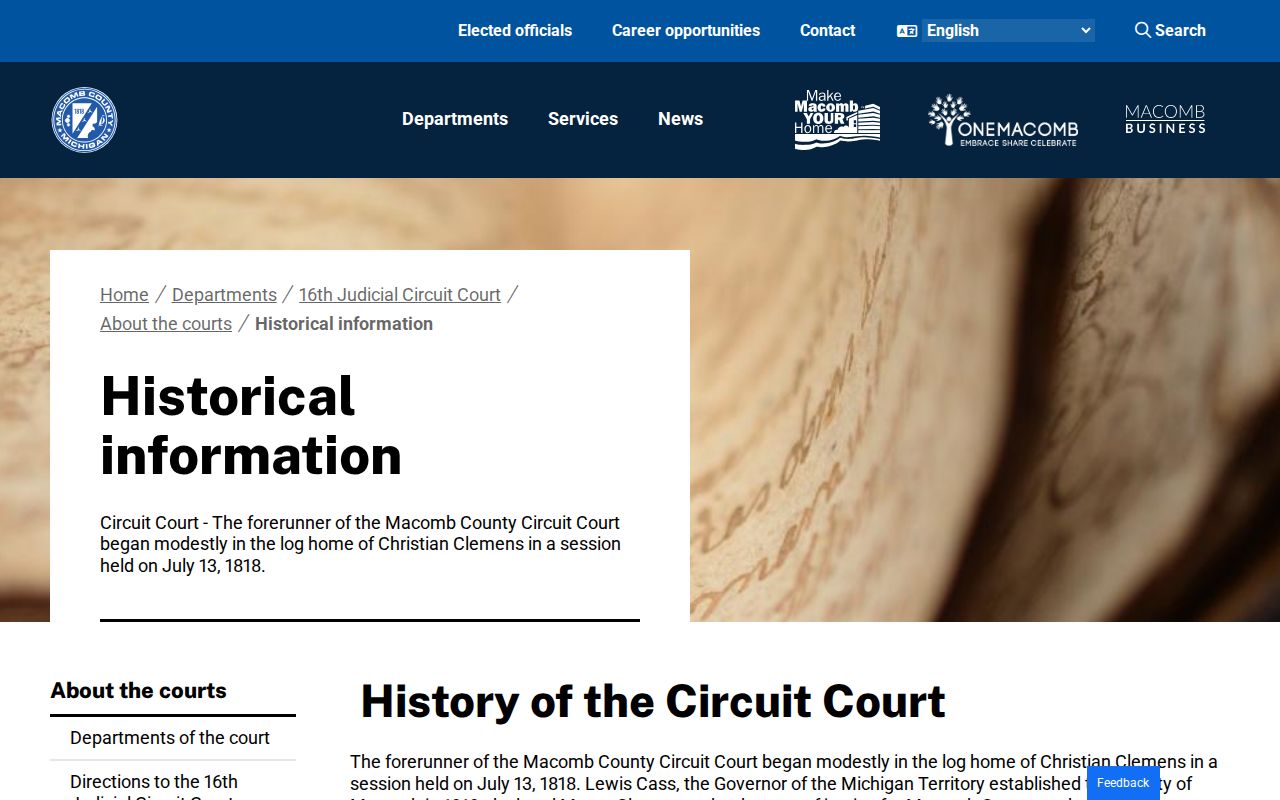
Macomb County was organized in 1818, but its first courthouse history has a documented conflict. One county source says the log courthouse burned in 1835. A county annual-report historical essay says it burned on Christmas Eve 1839 during an attempted jail escape and was replaced in 1840. Preserve that discrepancy in an early trail rather than choosing one date as certain. The larger point is that the earliest courthouse was lost, so continuity can depend on replacement books and later copies.
The county historical-information page provides the county's courthouse history and early-record context.
For any conclusion about who lived here before, keep the source, date, spelling, parcel description, and confidence level with the result.