
Macomb County City Directory Volumes
Mount Clemens Public Library holds the central local directory collection: its Master Index runs from 1896 through 1966. The online index is a way to find a name, not a substitute for the volume itself. The library also holds related obituary, funeral-home, church, yearbook, newspaper, map, plat, and census material. Together, those sources let a researcher build a dated household trail instead of relying on one listing. The research did not locate a complete publisher-by-volume list or a confirmed list of every missing volume, so those details belong in the title page and the physical volume check.
| Macomb collection | Date span | Custodian | Best access route |
|---|---|---|---|
| Mount Clemens directory master index | 1896-1966 | Mount Clemens Public Library Local History & Genealogy Room | Online name index, then request or inspect the volume |
| Property History sketches | Address-specific, current resource | Mount Clemens Public Library local-history collection | Address search and source review |
| Macomb County Obituary Index | 1941-present, with some older material | Mount Clemens Public Library | Online index and cited copy request |
| Newspaper microfilm | Roughly 1882-present, with title and date gaps | Mount Clemens Public Library | In-room reader and printer, or a research request |
| Sanborn maps and plats | Mount Clemens examples 1888-1945; plats from the nineteenth century | Library, county, state, and map repositories | Compare street, lot, building, and legal-description context |
The collection is centered on Mount Clemens, while Macomb County spans 27 local government units. A person who left the city may still appear in a Warren, Clinton Township, or rural township record under a different local custodian. Keep the city, township, and year beside each hit. That prevents a directory disappearance from being mistaken for a disappearance from the county.
Macomb County City Directory Index
The useful order is name index first, full volume second. Mount Clemens Public Library's directory master index is presented through an iframe, and the accessible source page does not publish its complete result fields. Record the spelling, directory year, and any citation returned. Then ask for the full entry or inspect it in the room. The library lists a $4 fee for an index-result photocopy when a citation is supplied, or $10 when the request has no index detail.
This is a local-directory myth worth avoiding: an index hit does not establish that someone occupied an address all year. It identifies a place to look in the underlying volume. A no-hit is also limited. It may reflect initials, a maiden or married name, a spelling variation, a gap, or a person who was not listed. Search names in more than one form and preserve the exact form printed in the volume.
For an illustrated starting point, the library's directory-index page is shown below.
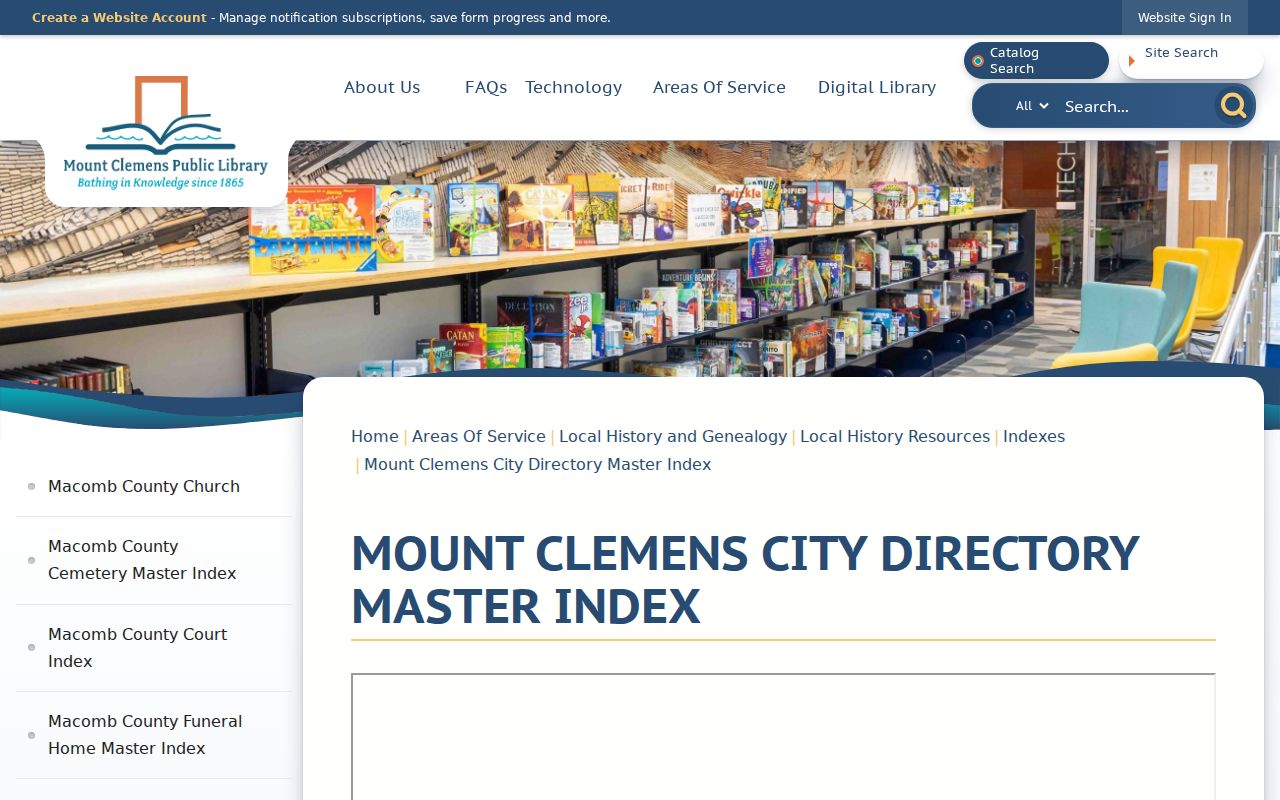
The index helps narrow a request, while the printed directory supplies the entry details that need to be cited and compared.
Macomb County Library Directory Trail
Mount Clemens Public Library's Local History & Genealogy Room, at 150 Cass Avenue in Mount Clemens, reports more than 300,000 print volumes and more than 5,000 microfilm reels. Beginning March 1, its posted room hours are Monday, Tuesday, and Thursday from 10:00 to 6:00; Wednesday from noon to 6:00; Friday from 10:00 to 5:00; and Saturday by appointment. Experienced genealogists can perform lookups by email, and Macomb County Genealogy Group volunteers assist during selected hours.
The room is more than a shelf of historical volumes. Its indexes include obituaries, cemetery records, probate, church material, funeral homes, military records, yearbooks, fire department material, and a locally produced 1930 census index. For a family that is hard to separate by name alone, those companion sources may explain an address move, a death, a marriage, or a service record.
The Local History & Genealogy Room page shows the research setting and its collection information.

Use the room's posted channels when the online index does not reveal enough to identify a volume or page.
Read a Macomb County City Directory
The official pages confirm the Mount Clemens collection but do not show a readable sample entry or a universal abbreviation key. Directory conventions can change by year and publisher. Inspect each volume before assigning a meaning to a mark. In a historical entry, look for the printed surname and given name, initials, spouse or widow notation if used, occupation or business line, street number, and street name. Some volumes may also have ownership notation, but that must be verified in the individual book.
| Name | Copy the spelling, initials, and relationship notation exactly as printed. |
|---|---|
| Occupation or business | Use it to distinguish similar names, then confirm it in a dated record. |
| Street address | Compare the house number and street with the reverse section, map, or census. |
| Spouse or widow notation | Check the volume's key before interpreting a parenthetical name or abbreviation. |
| Street section | Where present, it provides an address-led check on a person found alphabetically. |
- Criss-cross directory
- An address-oriented section that can list occupants or businesses by street rather than by surname. Its availability must be checked by year.
- Householder index
- A name route to a household listing. It may omit other people at the same address.
- Abbreviation key
- The explanatory list in a volume that defines its own shorthand. Photograph or transcribe it with the entry.
Macomb County Street Changes
Historic addresses are often the reason a local directory search seems to fail. The Mount Clemens street-change guide records many dated transitions, including Front to Broadway in 1925, First to AmVet Drive in 1957, and Boyer to Highland in 1896. Gratiot North and South were divided into North Main, Northbound Gratiot, South Main, and Southbound Gratiot beginning May 1, 1994. Search the period street name that fits the directory year, then test the present name against a plat, Sanborn map, deed, or census.
The library's local-history resources point researchers to street-name information, maps, and related materials. Old and current street names should stay together in the research notes, especially when one house has changed number or sits on a renumbered road.
Trace Macomb County City Directories
A year-by-year trail is more useful than a single discovery. Start with a known surname, city or township, and likely name variants. Note every address and year. Then pair the resulting directory sequence with the released federal census schedules for 1900, 1910, 1920, 1930, 1940, and 1950. Directories can show a change between census dates; a census can add household members, birthplace, and age. A move from Mount Clemens to another Macomb community calls for a jurisdiction check, not an assumption that the family left the county.
- Search the name index with full names, initials, maiden or married forms, and likely spelling variants.
- Request or inspect the cited volume and transcribe the entry, title page, and abbreviation key.
- Check the street section when the volume includes one, then record nearby names without assuming a family relationship.
- Pair a directory year with the nearest released census and compare address, age, household, and place information.
- Use an obituary, probate file, cemetery entry, deed, or newspaper notice to test a move, death, or ownership transition.
The library's genealogy research service explains request methods and copy-search fees for material that cannot be checked in person.
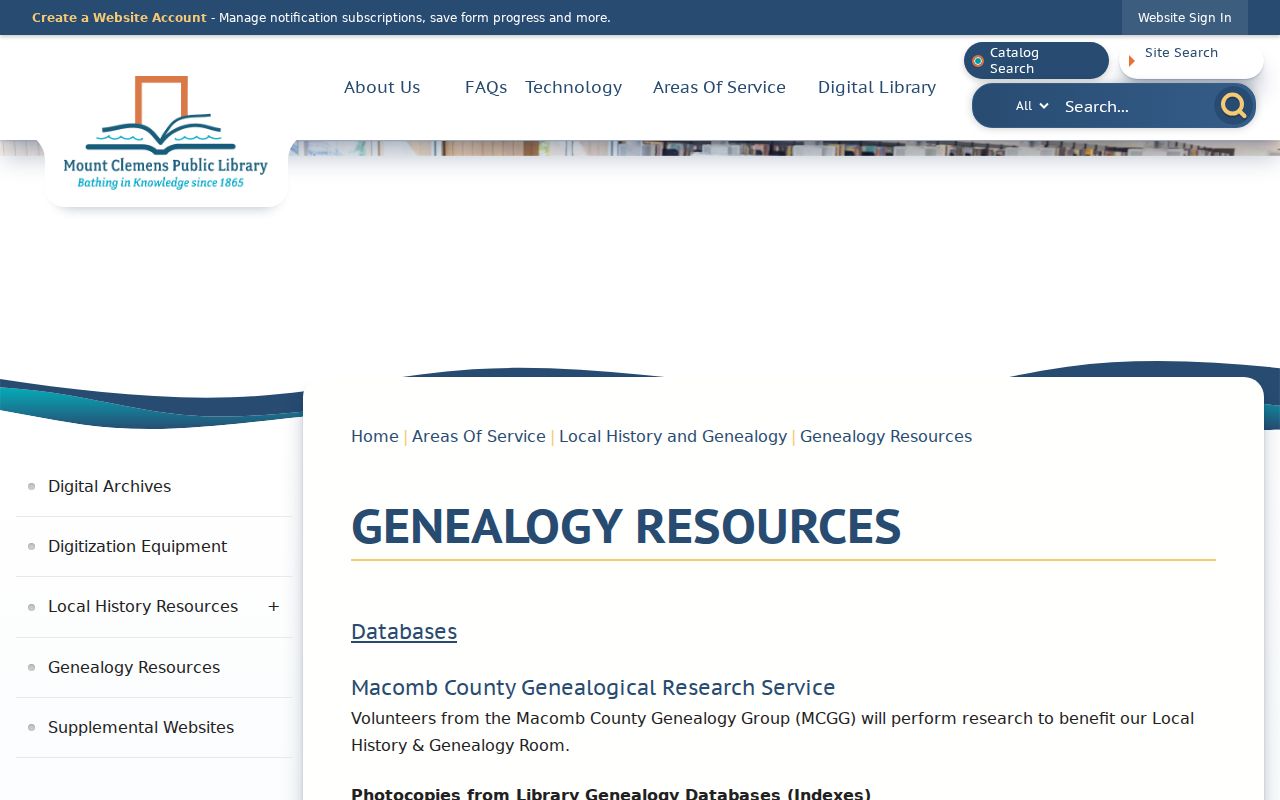
That request channel is especially useful when the index supplies a directory year but the researcher needs the complete entry or a related local record.
Macomb County Directory Newspaper Gaps
When directory years are missing or a household does not appear, the library's microfilm is a practical next step. Its newspaper holdings include Mount Clemens Monitor, Daily Leader, Mount Clemens Press, Daily Monitor-Leader, Macomb Daily, South Macomb News, Armada Times in part, St. Clair Shores News, Pageant of Progress, and Utica Sentinel in part. The library describes a fairly complete Mount Clemens newspaper run from 1882 to the present, but it also lists gaps in 1898, early and late 1902, and 1922. A negative search during a gap is not evidence that an event did not happen.
The library's locally built indexes include the directory, obituary, probate, cemetery, church, funeral, military, yearbook, fire, and census paths that can corroborate a name or address.
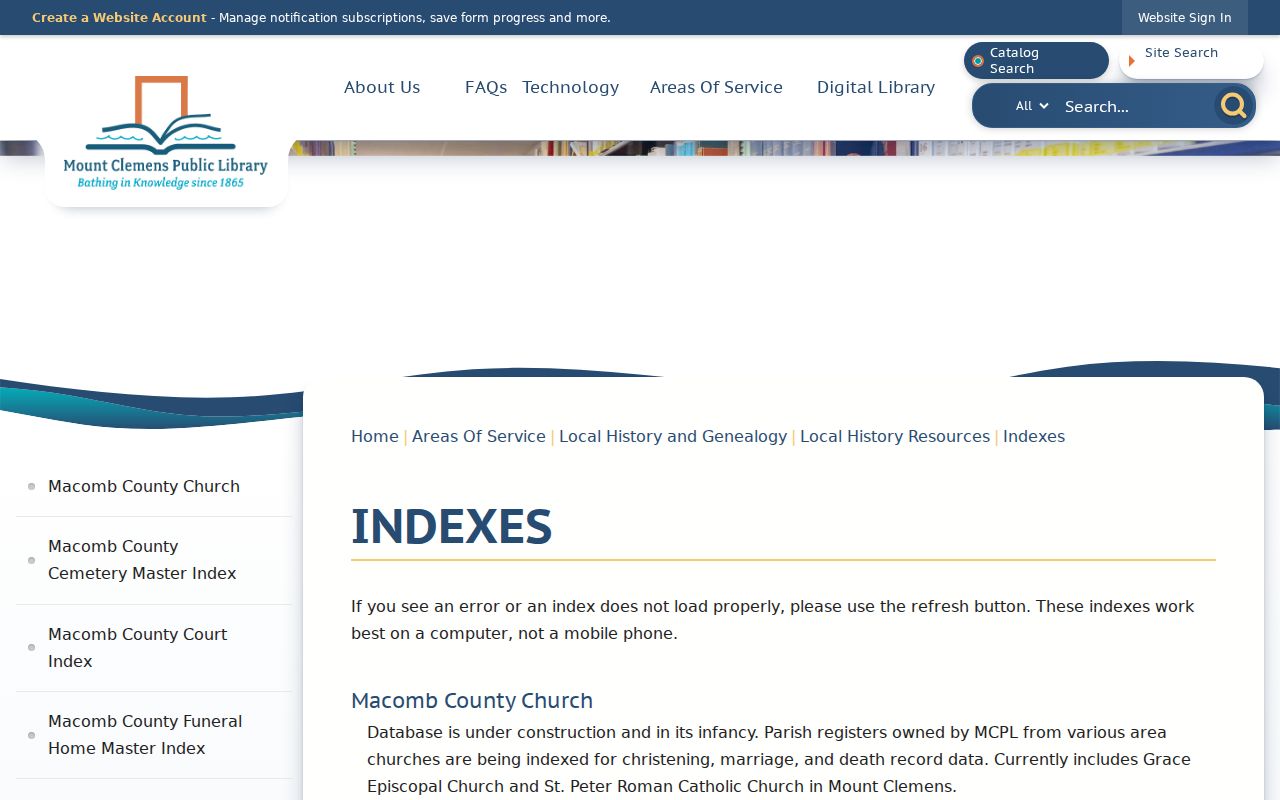
Use a newspaper notice as a dated lead, then verify the address or identity with the cited issue and another record type.
Macomb County Directory Dates Matter
Macomb County was organized in 1818, and early county material survives in several record groups, but the first courthouse was lost to fire. County sources disagree on whether that happened in 1835 or on Christmas Eve 1839. The useful research lesson is not to choose a date without noting the conflict. Early continuity may depend on replacement books, later indexes, library holdings, and Archives of Michigan record groups rather than one uninterrupted local series.
| 1818 | Macomb County was formally organized and Mount Clemens became the county seat. |
|---|---|
| 1896 | The documented Mount Clemens city-directory master-index run begins. |
| 1966 | The documented master-index run ends; later research uses other local record channels. |
| Modern access | Library indexes and research requests, GIS, land records, and court systems serve different record eras. |
The Macomb County Heritage Alliance resource list identifies local libraries and historical organizations that can add context for a directory find.
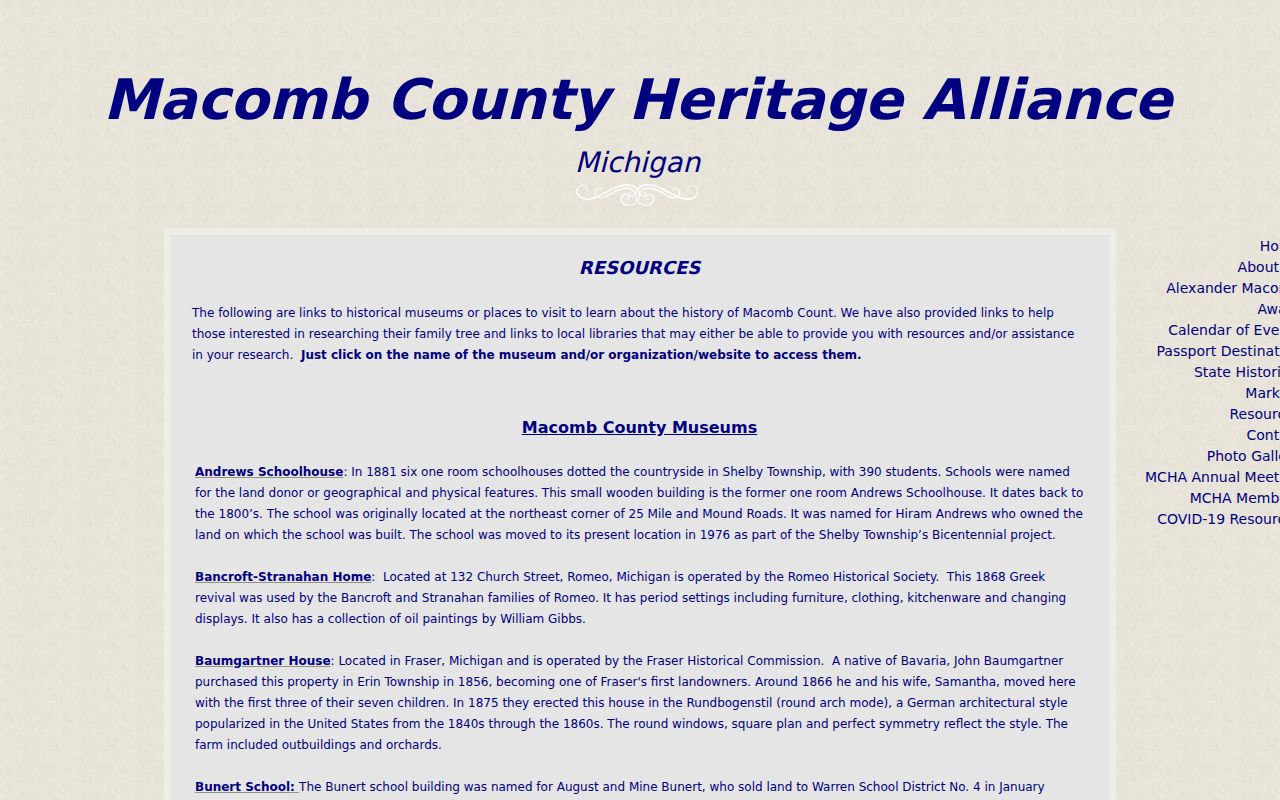
Record the collection name, year, volume, page, spelling, and unresolved gap so another researcher can verify the same Macomb directory trail.
Note: For a present-day parcel or street record, use the county's By Street directory rather than stretching a historical listing beyond its date.